







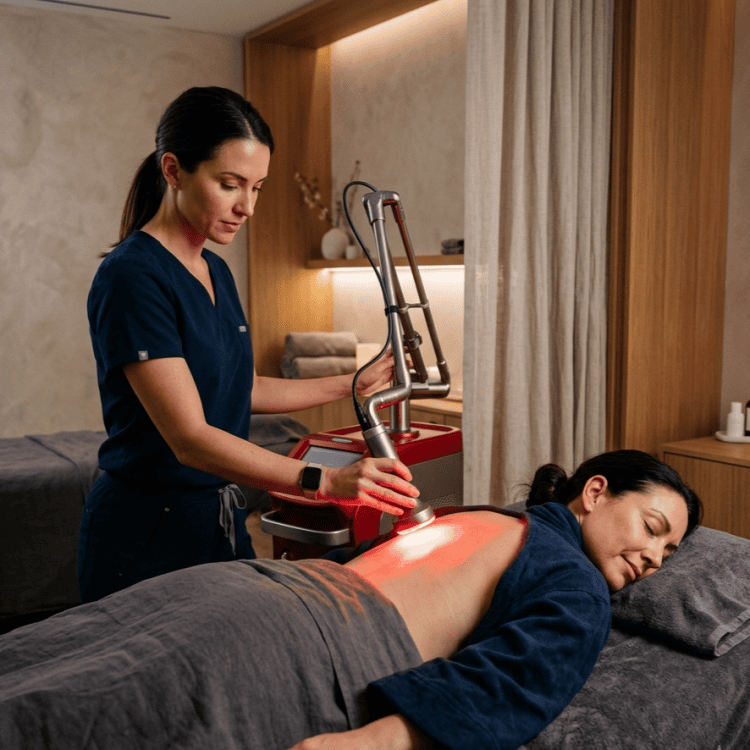

Red laser therapy works, and the clinical evidence behind it is stronger. Invisa-RED, the device used at Wellness Spot in Hurst, TX, holds FDA approval and IRB certification, and is backed by a 68-week, double-masked clinical trial (NCT03811093). That is a documented medical device with serious independent scrutiny.
If the idea has been sitting in the back of your mind, it is likely a handful of specific questions holding you there, ones that have gone unanswered. Most content on this topic reads either like a research abstract or a promotional brochure. Neither one tells you what you genuinely want to know before walking into a clinic.
These are the questions that come up in real consultations, the ones people sometimes hesitate to ask out loud. These answers are honest, plain, and straight from a team that has had this conversation hundreds of times at Wellness Spot in Hurst, TX.
Does Red Laser Therapy Hurt?
Sessions are completely non-invasive and painless. You lie comfortably while dual coherent laser frequencies are delivered to the treatment area. There is no heat, no pressure, no needles, and no recovery period. The sensation most people describe, if they notice anything at all, is mild warmth.
The confusion is understandable. The word “laser” carries associations with cutting, burning, and precision surgical procedures. Those are entirely different categories of laser technology. Invisa-RED uses low-level laser energy that is absorbed by fat cells, not used to damage or remove tissue. The mechanism is stimulation, and that surprises most people who walk in expecting something far more intense.
Is This the Same as the Red Light Panels at the Gym?
These are two different things, and the distinction matters before making any comparison.
Gym-style red light panels emit broad-spectrum, non-coherent light. That light primarily interacts with cells at the skin’s surface. Red laser therapy using Invisa-RED uses two specific coherent laser frequencies, 680nm and 980nm. One is calibrated for surface tissue. The other is calibrated to penetrate approximately 40mm below the skin, reaching the subcutaneous fat layer where the actual work happens.
Coherent laser energy travels in a focused, directed beam. Panel light scatters. That physical difference determines whether the energy ever reaches the fat cells it is meant to stimulate. This is the most important technical distinction in the entire red light therapy versus red laser therapy conversation. It is a matter of physics, and physics determines results.
How Many Sessions Will You Actually Need?
Any provider who gives a single number without knowing anything about your situation is skipping the honest answer. The truthful answer is: it depends on the individual.
What Wellness Spot can say is that Invisa-RED sessions are conducted as part of a structured program. The medical team develops a plan based on your starting point, body composition, and goals. Some patients see measurable changes early in the program. Others experience a more gradual progression. Both are completely within the normal range.
A provider willing to hold back a specific promise is one worth trusting. A free consultation is where your actual program gets outlined, because that conversation requires your specifics to be in the room.
Will It Work on Your Problem Areas?
Wherever subcutaneous fat tissue is present, the dual-frequency laser can reach it. That includes the abdomen, thighs, arms, and flanks. The biological process is the same regardless of location. Fat cells release stored triglycerides, ATP synthesis accelerates, and the lymphatic system processes and removes the released contents.
Invisa-RED is designed for body-wide fat reduction and contouring. Fat reduction from any source, including red laser therapy, tends to distribute across the body over time. That is how the body works, and patients who understand this going in tend to be far more satisfied with their progress. If your question is whether it works on belly fat or specifically on thighs, the answer is yes, with the full picture attached.
Is the Science Behind Red Laser Therapy Real?
The science is real, and there is documentation to prove it.
Invisa-RED is FDA-approved, IRB-certified, and supported by a 68-week double-masked clinical trial registered under NCT03811093. That is the kind of evidentiary standard that separates a medical device from a gadget with a light in it. The FDA approval process required independent scrutiny, the kind most aesthetic devices never go through.
Wellness Spot specifically uses Invisa-RED because of its clinical foundation. When the question is whether red laser therapy is clinically proven, the answer for this specific device is yes. The evidence required for approval was rigorous, and that is worth knowing before booking anything.
How Does Red Laser Therapy Fit Into a Real Weight Loss Program?
Invisa-RED is one component of a medically supervised program at Wellness Spot, and it works alongside other tools, never in isolation. For patients on GLP-1 or dual GIP+GLP-1 medications, Invisa-RED provides a complementary approach that targets fat tissue while the medication works through hormonal appetite regulation and metabolic signaling. The combination addresses weight loss from two biological directions at once, one hormonal and one physical.
For patients using red laser therapy as a standalone treatment, sessions still take place in a supervised clinical setting, with a medical director overseeing the program. The goal is a structured plan built around your situation, with Invisa-RED as one well-placed tool.
The Consultation Is Where the Real Conversation Starts
This article covered the questions most people carry into a first consultation. Every person’s body, goals, and starting point are different, and a genuine clinical conversation cannot happen in an article.
A free consultation at Wellness Spot is where those specifics get addressed, in an actual clinical conversation with a team that has heard every question, including the ones you have yet to ask. Wellness Spot Call at 817-849-2361 Location: 923 W Glade Rd, Suite C, Hurst, TX 76054
Frequently Asked Questions
Does red laser therapy hurt?
Sessions are completely painless and non-invasive. Patients lie comfortably while dual coherent laser frequencies are delivered to the treatment area, with no needles, pressure, cutting, or recovery period involved. The most common sensation reported is mild warmth, and many patients feel nothing at all.
What is the difference between red laser therapy and red light therapy?
Red laser therapy uses coherent laser frequencies directed at a specific wavelength and depth. In contrast, red light therapy panels emit broad-spectrum, non-coherent light that primarily affects surface-level skin cells. Invisa-RED uses dual frequencies, 680nm and 980nm, designed to penetrate approximately 40mm below the skin to reach subcutaneous fat tissue. Panel-based red light therapy does not achieve that depth of penetration.
Is red laser therapy FDA-approved?
Yes. Invisa-RED, the device used at Wellness Spot, is FDA-approved and IRB-certified. It is also supported by a 68-week, double-masked clinical trial (NCT03811093), which constitutes the type of independent clinical evidence required for medical device approval.
How many sessions are needed to see results?
The number of sessions varies by individual based on body composition, starting point, and goals. Invisa-RED is administered as part of a structured program, and some patients see measurable changes early while others experience gradual progression. Both outcomes are within the normal range.
Does red laser therapy work on belly fat?
Yes. Invisa-RED can be applied to the abdomen, and its dual-frequency laser penetrates to the subcutaneous fat layer in that area. The mechanism, which stimulates fat cells to release stored triglycerides processed by the lymphatic system, functions the same way in the abdominal area as it does in the thighs, arms, or flanks.
Is red laser therapy the same as laser liposuction?
These are two separate procedures. Red laser therapy using low-level laser energy is non-invasive and stimulates fat cells to release stored energy naturally. Laser liposuction is a surgical procedure that involves incisions and the physical extraction of fat. Nothing is cut, inserted, or removed during a red laser therapy session.
Can red laser therapy be combined with GLP-1 medications?
Yes. At Wellness Spot, Invisa-RED is used alongside GLP-1 and dual GIP+GLP-1 medications as part of a medically supervised weight loss program. The two approaches work through different biological pathways, making them complementary within a structured plan.
How deep does the laser penetrate during a session?
The 980nm wavelength used in Invisa-RED is calibrated to penetrate approximately 40mm below the skin surface, reaching the subcutaneous fat layer. The 680nm frequency is calibrated for surface tissue. This dual-frequency design is what distinguishes it from broad-spectrum red light panels.
Who is a good candidate for this type of treatment?
Adults looking to reduce subcutaneous fat in specific body areas and support a broader weight-loss or body-contouring goal are generally well-suited for this program. A free consultation with the medical team at Wellness Spot is the appropriate place to determine individual candidacy based on health history and goals.
Where can red laser therapy be found in the DFW area?
Wellness Spot in Hurst, TX, offers Invisa-RED as part of its medically supervised weight-loss program. The clinic is located at 923 W Glade Rd, Suite C, Hurst, TX 76054, and free consultations are available by calling 817-849-2361.