







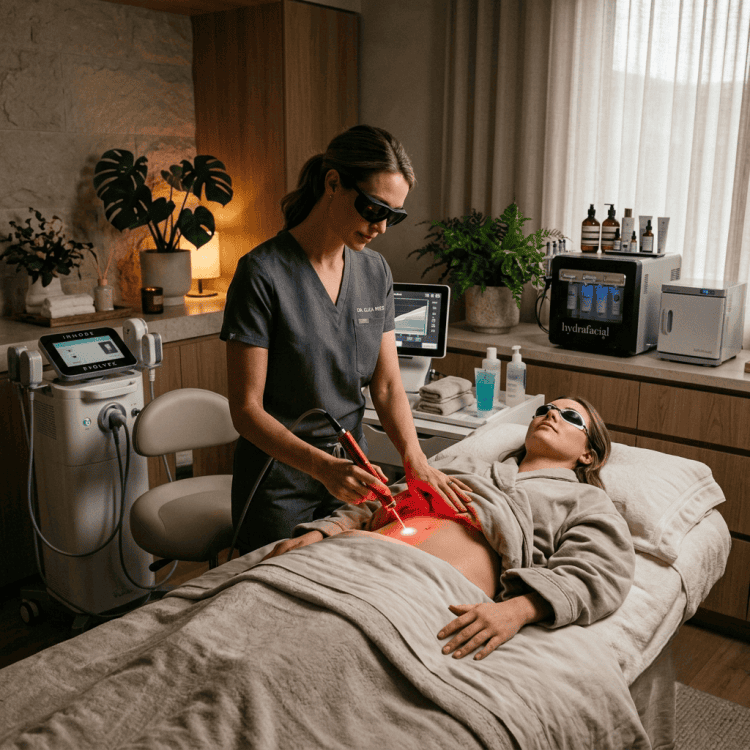

Every summer, body treatment trends get recycled with new names and new packaging. Red laser therapy stands apart from that cycle because its results are grounded in biology. The right starting point is a simple question: what does each treatment actually do at the tissue level, and does that biology align with the goal?
This blog runs a clear, mechanism-first comparison across five common treatment categories. Each one gets an honest look, including what it does well and where it stops working. Wellness Spot Weight Loss in Hurst, TX, is the reference point for how a medically supervised approach brings all of this together.
At-Home Red Light Panels vs. Red Laser Therapy
At-home red light panels are a legitimate tool for surface-level skin improvement. They support collagen stimulation in the dermal layers and provide evidence of skin tone benefits through a process called photobiomodulation. These are real effects for the tissue they reach.
The limitation is depth. Panels emit broad-spectrum, non-coherent light that disperses as it travels through tissue, stopping well short of the subcutaneous fat layer. This is a physics reality, and no panel intensity setting changes it.
Red laser therapy using the Invisa-RED system delivers two coherent laser wavelengths, 680nm and 980nm, in a focused beam that penetrates approximately 40mm into tissue. That is where subcutaneous fat cells are located. The two technologies serve different purposes, and understanding that boundary saves time and money.
Cold-Based Body Treatments and What Sets Them Apart
Cold-based body sculpting works through a well-studied mechanism. Fat cells are more vulnerable to cold temperatures. Sustained cold exposure triggers apoptosis, a form of programmed cell death, and the body gradually eliminates the destroyed cells through an inflammatory response over several weeks. The clinical evidence for this is solid.
The distinction with red laser therapy comes down to what happens to the fat cell. Cold treatments destroy fat cells. Invisa-RED causes fat cells to release their stored lipids through temporary pores, and the lymphatic system then processes and excretes that released material. The cells remain intact throughout.
One approach is destructive, and one is metabolic. Both address subcutaneous fat. For patients who prefer a cell-preserving, non-destructive process, or for whom cold treatments are a poor fit, that distinction carries real weight.
Body Wraps and Compression Treatments: a Direct Look
Body wraps produce temporary changes in measurements, and the mechanism behind this is fluid displacement. As the body restores normal hydration, typically within 24 to 48 hours, those measurements return to baseline. There is no fat cell involvement, no metabolic stimulation, and no lymphatic activation.
Body wraps fall into a different category entirely from light- or cold-based treatments. Placing them alongside red laser therapy as a comparable option would misrepresent what they do. For a short-term appearance change before a specific event, a wrap may serve that narrow purpose.
For anyone whose goal is measurable, sustained fat reduction, body wraps are a different tool for a different outcome. The science on this is straightforward.
Exercise and Red Laser Therapy: a Complementary Relationship
Exercise delivers systemic benefits that no body treatment replicates. Cardiovascular health, muscle development, mood regulation, and long-term metabolic function all come from consistent physical activity. Red laser therapy does none of those things, and Invisa-RED makes no claim to the contrary.
What cardio training cannot do is direct fat loss to a specific area. The body determines where fat is mobilized during systemic calorie burning, and for many people, certain areas, such as the abdomen, flanks, and inner thighs, resist change despite consistent effort. That is a documented physiological reality.
Invisa-RED addresses these specific areas through targeted subcutaneous application. The relationship between exercise and red laser therapy is complementary, each addressing what the other cannot reach.
Vibration Platforms and EMS Devices: Clarifying the Target
Whole-body vibration platforms and electrical muscle stimulation devices stimulate muscle tissue. They activate motor neurons and support circulation and recovery, and those are legitimate benefits for the tissue they engage. Evidence for meaningful fat reduction through either modality, though, remains limited.
These devices target a different tissue. Muscle activation is not fat cell stimulation; the two outcomes are biologically distinct. For someone whose primary goal is subcutaneous fat reduction, vibration and EMS are working on something else entirely.
They are available tools with real applications. They are simply working toward a different result.
What Red Laser Therapy at Wellness Spot Actually Does
Invisa-RED delivers two coherent laser frequencies to the subcutaneous fat layer. The 680nm frequency interacts with fat cell membranes, and the 980nm frequency stimulates mitochondrial ATP synthesis. Fat cells release stored triglycerides and fatty acids through temporary pores, and the lymphatic system processes and excretes the released material. Cells are preserved throughout.
The treatment is non-invasive, produces no thermal damage to surrounding tissue, and is conducted in a medically supervised clinical setting. For patients across the DFW area, Invisa-RED is available at Wellness Spot Weight Loss at 923 W Glade Rd, Suite C, Hurst, TX 76054, serving Bedford, Arlington, Southlake, North Richland Hills, and the wider Dallas-Fort Worth region.
Invisa-RED is one part of a full program. Wellness Spot also offers medically supervised GLP-1 and dual GIP plus GLP-1 compounded medication options for appropriate candidates, supporting fat reduction through multiple biological pathways when clinically indicated.
The Comparison That Matters Most Is the One You Make for Yourself
Each treatment covered in this blog works through a specific mechanism targeting a specific tissue. The right choice depends on personal goals, health history, and what has already been tried. A treatment that works well for one person may be the wrong fit for another.
Wellness Spot offers free consultations that cover all available options. Whether someone comes in curious about red laser therapy, weight-loss medication, or the full program, that conversation is built around an individual assessment.
Whether the goal is targeted fat reduction, metabolic support, or a supervised plan that combines both, a free consultation is where that gets sorted out. Call 817-849-2361 or visit 923 W Glade Rd, Suite C, Hurst, TX 76054 to get started.
Frequently Asked Questions
Does red laser therapy actually work for fat loss?
Red laser therapy using coherent dual-frequency laser technology has a documented mechanism for fat reduction. It stimulates fat cells to release stored lipids, which the lymphatic system then processes and excretes. Results depend on the technology used and whether the system can reach the subcutaneous tissue.
What is the difference between red laser therapy and at-home red light panels?
At-home panels emit broad-spectrum, non-coherent light that disperses before reaching subcutaneous fat tissue. Coherent laser systems like Invisa-RED use directed, dual-frequency beams that penetrate to approximately 40mm. This is a physics difference, and the two technologies serve different purposes.
How does red laser therapy compare to cold-based fat treatments?
Cold-based treatments induce apoptosis in fat cells via temperature-dependent mechanisms. Red laser therapy causes fat cells to release their contents without destroying the cells. Both address subcutaneous fat, and the right choice depends on whether a destructive or metabolic approach is preferred.
Is red laser therapy safe?
Invisa-RED is non-invasive and preserves fat cells and surrounding tissue throughout the treatment. It produces no thermal damage and requires no recovery time. A qualified provider assesses candidacy during a supervised consultation.
Can red laser therapy be used alongside exercise?
Yes, and the two are designed to complement each other. Exercise supports systemic metabolic and cardiovascular health, while red laser therapy targets stubborn subcutaneous fat that persists despite consistent activity. The combination addresses what each approach handles independently.
Do body wraps reduce fat?
Body wraps temporarily alter measurements through fluid displacement. Measurements return to baseline as normal hydration is restored, typically within 24 to 48 hours. There is no fat cell involvement and no lasting fat reduction.
How many sessions of red laser therapy are needed?
Session requirements vary based on the treatment area, the amount of subcutaneous fat present, and individual lymphatic clearance rates. A medically supervised consultation at Wellness Spot provides a realistic session plan based on individual assessment.
Where can patients in the DFW area access red laser therapy?
Red laser therapy via Invisa-RED is available at Wellness Spot Weight Loss, 923 W Glade Rd, Suite C, Hurst, TX 76054. The practice serves Bedford, Arlington, Southlake, North Richland Hills, and the wider Dallas-Fort Worth area. Appointments can be scheduled by calling 817-849-2361.
Does EMS or vibration therapy reduce fat?
EMS and vibration devices stimulate muscle tissue, support circulation, and promote recovery. Evidence for meaningful fat reduction with either modality is limited because they target different tissues and serve different purposes.
What else does Wellness Spot offer alongside red laser therapy?
Wellness Spot offers a full, medically supervised weight-loss program that includes GLP-1 and dual GIP/GLP-1 compounded medication options for appropriate candidates. The program is built around individual assessment, and the free consultation covers all available options.